Welcome to Woodworks Made Easy

Practice any art, however well or badly, not to get money and fame, but to find out what's inside you.
--- Kurt Vonnegut

Pictures are meant to be self explanatory, and for visual clarity you may
click on each photo to enlarge. For older projects see Blog Archive. I don't specialize on a particular genre so there is quite a variety of projects for a number of different interests.

Even if you are not a woodworker but you like some or all of the projects, have your local crafts person make them for you from the ideas and photos you see here. For a particular project just click the specific title on the Blog Archive list (right side column below).

For anyone willing to learn or begin to do woodworking for the first time, please read first from the Blog Archive, "How and Where to Begin a Woodworking Hobby.

And it is not for men only. Read my note on "Women in Woodworking" from Blog Archive, April 2010.


click on each photo to enlarge


Friday, February 18, 2022

The Grow Light

Grow lights, not too long ago, were a bulky affair of long fluorescent bulbs or electric energy sapping spot lights.  Now, they come in compact LED light bulbs with full RGB spectrum (red, green, blue).  Threaded for standard sockets, any desk lamp will work for house plant lighting needs. Naturally, in lieu of commercial desk lamps, a woodworking project will have to come along.


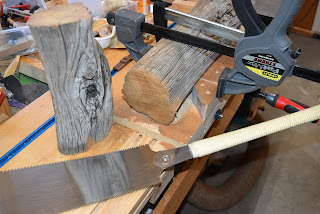
A while back a friend of mine brought home a section of fence post lying on a field he picked up in one of his hunting trips. It is Texas mesquite. Hard and durable like granite. It's probably at least a hundred years old. I used a Japanese hand saw to cut a section.  It is too irregularly-shaped to safely cut on the table saw.


And there was a pecan board waiting to be worked on.


A jointer makes easy work of flattening one side.


I had meant for the fixture to be by one of the windows ..


.. but I was overruled to place it somewhere else.


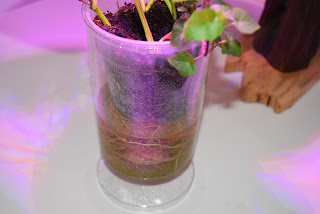
The planter is a semi-aquatic system.  The bottom half is filled with water. Plant roots quickly found the water in no time.


The full spectrum grow light makes for a unique accent lighting as well.


Entire project was practically all from scrap wood


Speaking of scrap wood ...

Another worthwhile project is this.  Vehicle FOBs could use a spot where they can be "dropped off".  By setting them at one particular place consistently, avoids having to look for them each time one is getting ready for a drive.  It will take a while but once it becomes a habit, you know where they are.


Next to where one usually leaves the wallet (with the driver's license, of course)


Saturday, January 8, 2022

"Milking" This Levitating Thing

I realize now that polycarbonate (Lexan is one trade name) - a derivative of petroleum, i.e. plastics - is more than just a curiosity or trick material in woodworking.  It is strong and stable. It can be cut and shaped and polished like wood but unlike the latter it is clear as glass but will not shatter easily. Used as part of a project, albeit in a strategically limited way, it actually enhances and strengthens the project and make them appear to float.  


So, for one more time, an opportunity presented itself by way of excess, "scrap" material from an earlier use of polycarbonate in making a woodworking jig. There were enough pieces to make one project to again showcase the utility of polycarbonates.

The two one-trick pony filet knives (to filet is their only one trick) begged to hangout next to each other.  They do well with that one trick so I obliged to grant their request.


And there they are.


They also begged to be photographed in silhouette.  


It was understandable one of the filet knives got jealous when at first only one of them was on a pedestal


And unlike the other denizens of the kitchen the filet pairs live in a nice area while the rest are in a crowded housing complex of city dwellers, relatively speaking.


Friday, November 26, 2021

Small Portable Bench

Over the years of hobby woodworking I've made the "torsion box design" a specialty favorite when constructing projects that are lightweight, yet extraordinarily rigid and practically unflexing but carry loads multiple times their weight.  Copied from how airplane wings are constructed, the torsion box uses thin skins of, say, 1/4 inch oak or walnut veneers, over latticed lightwood ribs to make a top platform.  This top will look like a thick slab but is mostly air inside.  The two long benches shown below can be carried one handed but each one can seat three adults without flexing.  The recent short bench featured in this blog is barely six pounds.

Why the short portable bench?  When one reaches a certain age - yours truly a good example - when bending, stooping, squatting are no longer so easily  achievable without thinking about a groan-free recovery just for standing up afterwards, a portable short bench, a short stool, is literally an answer from heaven.  The short bench  is mandatory for us of a certain age when working on anything lower than the strike zone in major league baseball.  It will save anyone from invoking the names of minor or major saints, or the classic OMG, just  to stand up.

Of course, purchasing one is the easier route but, hey, this is a woodworking blog.  

(Below) Finished small bench next to a full size one


Another torsion box bench (below) at the end of our bed


A simple drawing or sketch is good but where possible an actual "life-size" scale is best.


The "ribs" that make up the "innards" can be made from pine (weight consideration).


The glued up "ribs" will soon be cladded with the plywood skin using only glue and pin nails.


The top "skin" below is 3/8 inch oak (shown with finger hold already routed out).


Glue and pin nails complete the clad


The legs are one-inch thick solid oak (tapered on a jig)


Using only glue the legs are clamped together


No hardware of either screws and nails were used.  Dowels make sense but I used a through dowel system. The dowels were inserted through from one side as opposed to the true blind dowel assembly.  This is the easier method.  The pieces are glued together first.  Then the holes are drilled through on the joined pieces.  There is no chance for mismatched dowel holes  which could happen when done the conventional way. This is only possible, of course, when the pieces are narrow enough to make it practical.  


Four 3/4 inch dowels will anchor the legs to the top (set). I created a jig to ensure matched holes for the dowels. Shown below the Forstner bit guided by the jig to the legs


Below is the latest gizmo to inhabit the shop. A drill guide that makes any hand drill into a portable bench drill press with more capability.  It is an amazing tool, very well made, though pricey.  It makes drilling perfectly vertical holes into wide boards that a drill press may not be able to do (when holes are in the middle of the board) and then some. 


When not in use, it is easily stored (below) on a small foot print.


Final glue up (below).  Fastening the legs to the bottom of the seat


Now, the anguish of working at low level is greatly diminished. And a project boot.  So, take care of those joints, your knees, your back.


Why I customized the short bench?  I made its dimension so when I sit on it my thighs are parallel with the floor, keeping all joints at near neutral alignment.  Does that make sense?  You can find out.  Try it on commercial benches.  If one meets that criteria, buy it.  It's a useful, if not healthful, gift to yourself this season.